Here is a good resource page for prayers for the dying in the Catholic tradition, including scripture readings, prayers at bedside, graveside and for mourning.
 image courtesy of asik.site
Here is a good resource page for prayers for the dying in the Catholic tradition, including scripture readings, prayers at bedside, graveside and for mourning.
image courtesy of asik.site
Sadhguru gives a very clear and informative 9 minute talk about the dissolution of the energies at death. Including: Five basic manifestations of energies: Samana Prana Udhana Apana Viyana their characteristics and how they leave the body. Hell and Heaven as experiential realities during the passing process. Some hints about practices to help the voyager, how cremation can be beneficial.
From the last sentence: “There are many rituals to see that your influence, that you can somehow put a drop of sweetness into that non discerning mind so that the sweetness will multiply many fold and they will live comfortably or they will live in a certain self induced heaven, that’s the idea behind the ritual if it is done properly.”
This is so clearly presented, well worth watching, a real eye opener!! The Importance of Death Rituals.
They say that stress is 10 percent action, 90 percent reaction. Here is a great exercise from the LRS Readers Course (and also the book Practical Work on Self by EJ Gold) that will help you deal very effectively with, yes, even the Long Island Expressway.
Individual Exercise: The Pond
Purpose: To strengthen your ability to tolerate the states experienced in the Labyrinth.
Exercise: Our reflex reactions toward the manifestations of others are the chief cause of the automatic arising of lower-emotional storms within the organic body. Think of the organic body as a calm pool of water, and the shock of impressions from one who is for us a “walking-source-of-irritation” as pebbles. The ripples from dropping a pebble in the water would represent the reverberations that spread through the body. As we would expect, certain pebbles cause greater effect than others. Also, we should be aware that reverberations occur not only on the surface but under the surface as well. This week, we will “open the water” before the pebble so as to offer no resistance to the pebble; thus the ripples do not occur. We could learn to “open the water” before the reflexive reactions of the body are engaged from the impact of the annoying manifestations of others.
Recently we are seeing an uptick in interest in death and dying teachings and especially in the concept of the between lives state which our culture has ignored for several hundred years. Fortunately the Tibetans have kept the knowledge about the Bardos – the core teachings about the nature of the whole of existence – alive and accessible to us.
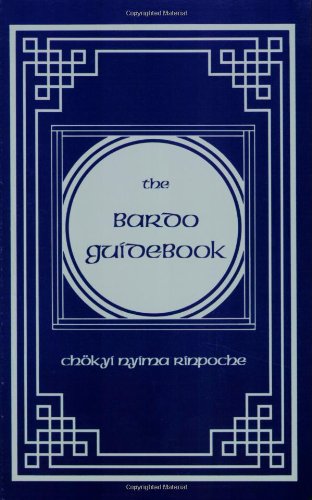
The Bardo Guidebook postulates: “Existence is an endless cycle of experience called the four bardos. These four periods include our present life, the process of dying, the after-death experience, and the quest for a new rebirth. Drawing from his intimate knowledge of the innermost Vajrayana teachings, the Tibetan master Chokyi Nyima Rinpoche presents in The Bardo Guidebook straightforward, direct instructions on how to deal with the four bardos.”
According to the Buddhist teachings we can use our valuable time in this life to prepare for our death. “The Buddha…gave many teachings…but they can be condensed into a single sentence: Train right now in the path luminosity so that at the moment of dying you can dissolve confusion into the ground luminosity.”p128
Many excellent books about the Bardo teachings are available and this one stands out for the straightforward, incredibly clear nature of its exposition. Available in ebook and paperback. Highly recommended! Here are some other highly recommended texts: Luminous Emptiness by Francesca Fremantle is comprehensive and scholarly. Mind Beyond Death by Dzogchen Ponlop, is very important. The American Book of the Dead by EJ Gold, the Tibetan Book of the Dead interpreted by Chogyam Trungpa and the Tibetan Book of Living and Dying by Sogyal Rinpoche all give the practical instructions on how to do practices and readings for others.
Wherever You Go There You Are: Mindfulness Meditation in Everyday Life
Jon Kabat Zinn 1994 Hyperion
In a crowded and overly hyped market of books and teachings on mindfulness and meditation this is the book that I was hoping to find. Written by one of the pioneers in the field and the co-founder of the Mindfulness Based Stress Reduction Clinic in Boston, this is the book that brings together all of the knowledge that Kabat-Zinn has gained from working with thousands of people. This wonderful book follows his ground breaking Full Catastrophe Living and is not a new book, published in 1994, but it is a new discovery for me. It is a practical handbook that you can open at any place and start reading to find something to work with right on the spot, or read through as a step by step guide to learning and improving your mindfulness and meditation practice. I keep it out and as possible consult it for brief readings throughout the week.
For example, this morning I was feeling restless about a few things and could hardly concentrate on getting ready for work. I stopped and opened the book to:
“Try: The next time you feel a sense of dissatisfaction, of something being missing or not quite right, turn inward just as an experiment. See if you can capture the energy of that very moment. Instead of picking up a magazine or going to the movies, calling a friend or looking for something to eat or acting up in another way, make a place for yourself. Sit down and enter your breathing, if only for a few minutes. Don’t look for anything – neither flowers nor light, nor a beautiful view. Don’t extol the virtue of anything or condemn the inadequacy of anything. Don’t even think to yourself, “I am going inward now.” Reside in the center of the world. Let things be as they are.” p.98

Filled with quotations by Thoreau, Whitman, the Dalai Lama, the Chinese Taoist masters and others this book contains all of the teachings. It, in itself, truly is enough. Chapters are short and in the form of readings. Interspersed with the chapters are practical and effective activities which can be practiced throughout the day and usually which take only a few moments to complete.
“Try: Staying with one full in-breath as it comes in keeping your mind open and free for just this moment, just this breath.” p. 19
“Try: Asking yourself from time to time, “Am I awake now?” p.27
The book discusses just about every aspect of mindfulness, from working with the breath, to waking up, to non- doing, patience, loving kindness, walking meditation, concentration, parenting and many many more. It is absolutely a must have for anyone who is interested in the subject.
Awakening, or practicing mindfulness does not seem easy, but in reality it is the simplest of all things. It is a struggle because in today’s society there is much reinforcement to consumption and stimulation. We want to get as much accomplished as quickly as possible throughout the day. The wonderful thing about the path of mindfulness, and what really makes it relevant to western culture today is that we can practice non-doing in action:
“Non-doing can arise within action as well as in stillness. The inward stillness of the doer merges with the outward activity to such an extent that the action does itself. Effortless activity. Nothing is forced. There is no exertion of the will, no small minded “I,” “me,”or “mine” to lay claim to a result yet nothing is left undone. Non-doing is a cornerstone of mastery in any realm of activity.” p.40 (italics mine)
Mindfulness is mostly a matter of practicing some self reflection, increased concentration of attention on activities without rushing, and being kind to yourself and others. Practice gently and you will simply find yourself awake in the present moment while the doing is happening. This gives a wonderful feeling of freedom, like a breath of fresh air for your being.
Be sure to pick up this book! It will give you plenty of material to get started on the path to awakening without beating yourself (or others) up. The path doesn’t have to be complicated, religious or even spiritual. It is very simple and practical. Just follow the advice of this author, he is a well studied and trustworthy guide.
“If your mind isn’t clouded by unnecessary things, This is the best season of your life.” Wu-Men p.16
A good review by Parul Sehgal of a new must read book by Sallie Tisdale: Advice for Future Corpses (and Those Who Love Them): A Practical Perspective on Death and Dying
“Consciousness is no longer grounded in the body; perception and sensation are unraveling. The entire braid of the self is coming unwound in a rush. One’s point of view must change dramatically.”

Sallie Tisdale credit Rachel Wolf
Tisdale does not write to allay anxieties but to acknowledge them, and she brings death so close, in such detail and with such directness, that something unusual happens, something that feels a bit taboo. She invites not just awe or dread — but our curiosity. And why not? We are, after all, just “future corpses pretending we don’t know.” This remarkable book is also available on Amazon.com